Shabbat: what it is, what you do, what is forbidden
In short
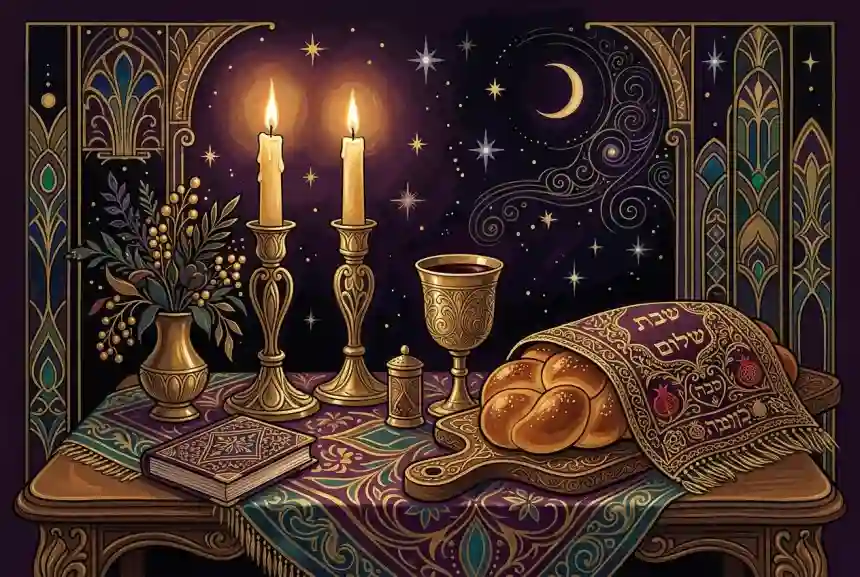
Shabbat is the weekly day of rest, from sunset on Friday to nightfall on Saturday. It is not only a list of prohibitions: it is a rhythm, with its candles, its meals, its study and its quiet. The point is not to "do nothing," but to step out of the week's work into a different kind of time. This page gives you the whole picture, and points to a practical guide at every stage.
When Shabbat begins and ends
Shabbat comes in on Friday, a little before sunset, at the lighting of the candles, and ends on Saturday night at nightfall, with Havdalah. The exact times change every week and from place to place: go by your community's calendar.
The spirit of Shabbat
Resting, in the sense Shabbat means, is not idleness: it is ceasing to act upon the world (creating, transforming, producing) in order to inhabit time differently. That is what gives the prohibitions their meaning: they trace out, in the negative, a space of rest, of presence and of connection.
What is forbidden, plainly
Shabbat forbids certain categories of labor, the "39 melachot," from which the concrete rules follow. They are easier to grasp through their logic than through the list. One category of its own, muktzeh, covers the objects we do not handle on that day.
The 39 forbidden labors · Muktzeh
Electricity and appliances
This is the most common question, and the most disorienting at first: the phone, the lights, the fridge that switches itself on.
Electricity and appliances on Shabbat
Cooking and eating
Everything is made ahead of time and kept warm under precise rules. The meals are a heart of Shabbat.
Cooking and keeping food warm for Shabbat
The three meals, and the delight of the day
Three meals mark out Shabbat, with songs at the table. The first two open on two whole loaves; at the third, custom varies from one community to the next: two loaves, or a single whole loaf. That is what the word oneg, delight, is saying: the day is not only observed, it is savored.
Oneg Shabbat: the delight of the day
What to do with your time
Twenty-five hours without a screen sound frightening at first, then often turn into the best of Shabbat: meals, study, walking, games, and above all other people.
What to do with your time on Shabbat
Everything is made ready on Friday
Friday is not an eve: it is already Shabbat being set in place. Everything that calls for action is settled before the onset, from the shopping to the clothes, from the food kept warm to the timers. This preparation is not housekeeping: it is the kavod, the honor paid to the day.
Preparing for Shabbat, step by step
How it begins: the candles
Shabbat is brought in by the lighting of the candles, just before sunset.
The words of Shabbat: Kiddush and Havdalah
Shabbat opens and closes with speech: the Kiddush sanctifies it over a cup of wine before the meal, and Havdalah separates it from the rest of the week at nightfall. Text, transliteration and translation on each page.
The Shabbat Kiddush · Havdalah
The prayers of the day
A fourth service is added to the three of every day: Musaf, said in the morning, right after the Torah reading. The central prayer changes as well: we ask nothing for ourselves in it, because a day of rest is not a day for requests.
The Shabbat services, from Friday evening to Saturday night
Step 1 / 4
Sorting
Sort: what Shabbat is, what it is not
Drag an item into its basket.
0 · 4 sorted
Frequently asked questions
Do I have to take it all on at once? No. Shabbat is learned and settles in by stages, guided by a rav. One step at a time.
Isn't Shabbat boring? Many fear it will be, few find it so afterwards: it is another rhythm, not an emptiness.
Where do I find the exact times? From your community or a Jewish calendar: they change every week and from city to city.
Sources: this guide draws on the classical sources of Jewish law. It gives a general orientation, never a ruling that takes the place of your rav's. On concrete cases, ask your rav.